This Week’s Bit of String: French Wars of Religion
Our first views of the Dordogne region, after landing in Bergerac’s two-chamber airport in 36-degree heat, were flat and bright. The only break in the horizon seemed to be a single spire in the distance.
That spire turned out to be very near our destination. Last week, I accompanied my talented musical husband and a 21-piece band to Bergerac, which our town is newly twinned with. They host a jazz festival, Jazz Pourpre, each year and our local big band would play 3 different gigs in as many days.
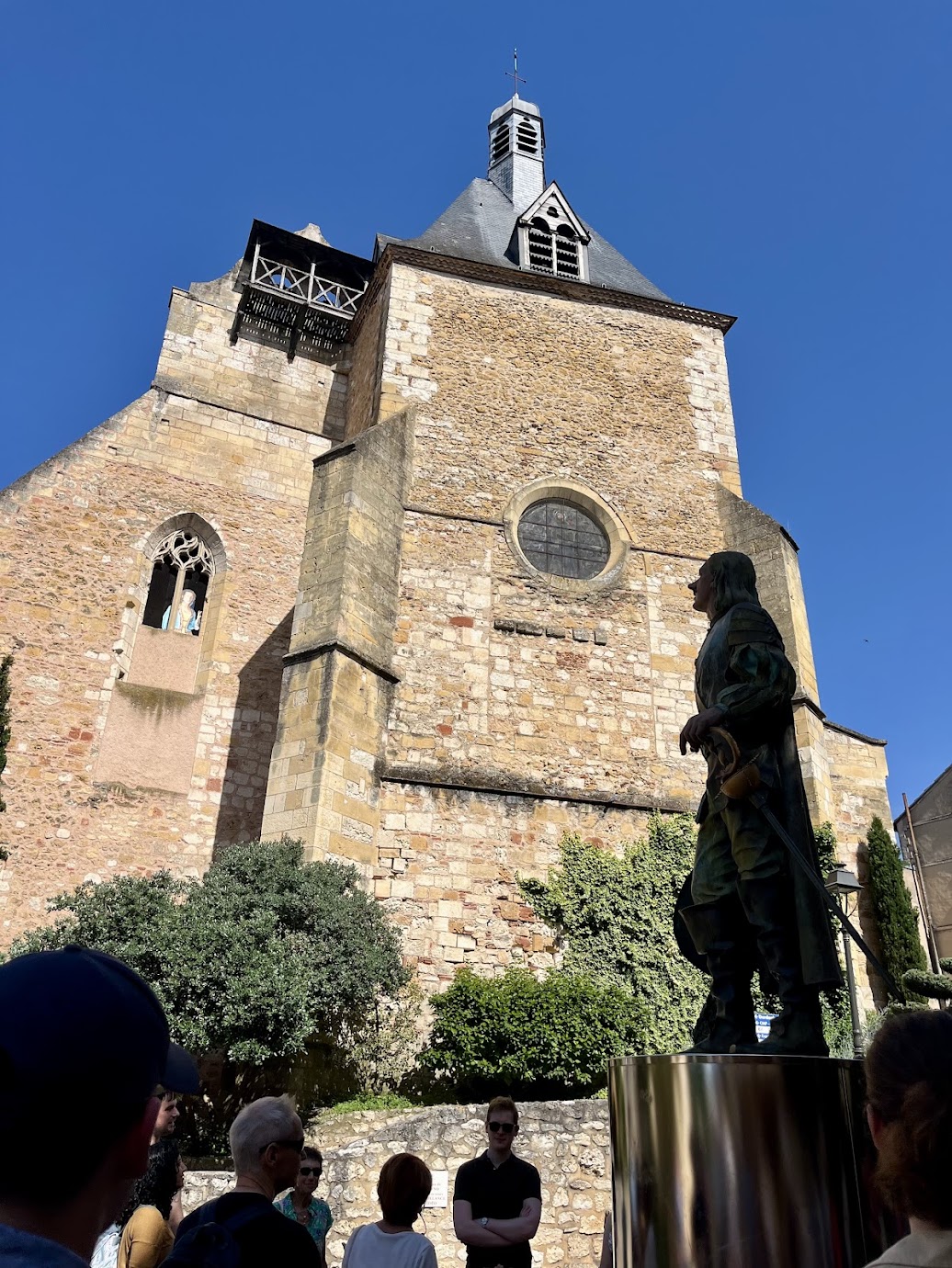
Jazz Pourpre takes place behind the mid-19th century church of Notre Dame. At the opposite end of the street is a monument to the French Resistance, so the band played their final concert under the word RESIST running down the obelisk into the white peak of the tent.
I don’t know how strong the Resistance was in Bergerac during World War II. But it has sometimes been staunch in its individuality. It was a Huguenot stronghold in the 16th century, during the Wars of Religion, and most Catholic buildings were destroyed while the nuns and clergy were enslaved or executed. Hence the formidable height of the Notre Dame, built later in the 1800s with a vengeance.
The great old church of Saint James was left standing, but emptied out and used as a fortress. Among all the relics the Protestants destroyed was a supposed piece of Christ’s cross, gifted to the town by Charlemagne when he passed through. I know there’s little chance it was an authentic artefact from Biblical times, but having been treated as such for eight centuries, that scrap of wood would have been the subject of prayers and pilgrimages and played a role in many lives.
Sometimes a story’s worth lies in what it means to people, not its authenticity.
Atrocities were committed on and against both sides in those wars. There were terrible massacres of Protestants, which our French Catholic guide didn’t mention specifically. But on our tour of the town, she did tell us: “At that time, a human life was worth no more than a chicken.”
Tale Keepers
I kept busy exploring and scribbling about what I found, while my husband and the band played and managed various logistics. Our French hosts from the Twinning committee would wander over and ask me what I was writing about.
One monsieur elaborated on the far-reaching effects of the Wars of Religion. When the Catholics “won,” he said, many Protestants fled the country. But they didn’t want to live without the wines of Bergerac, so they established trade and Bergerac shipped wines up the Dordogne River. Taverns in Bristol were supplied by Bergerac at one time.
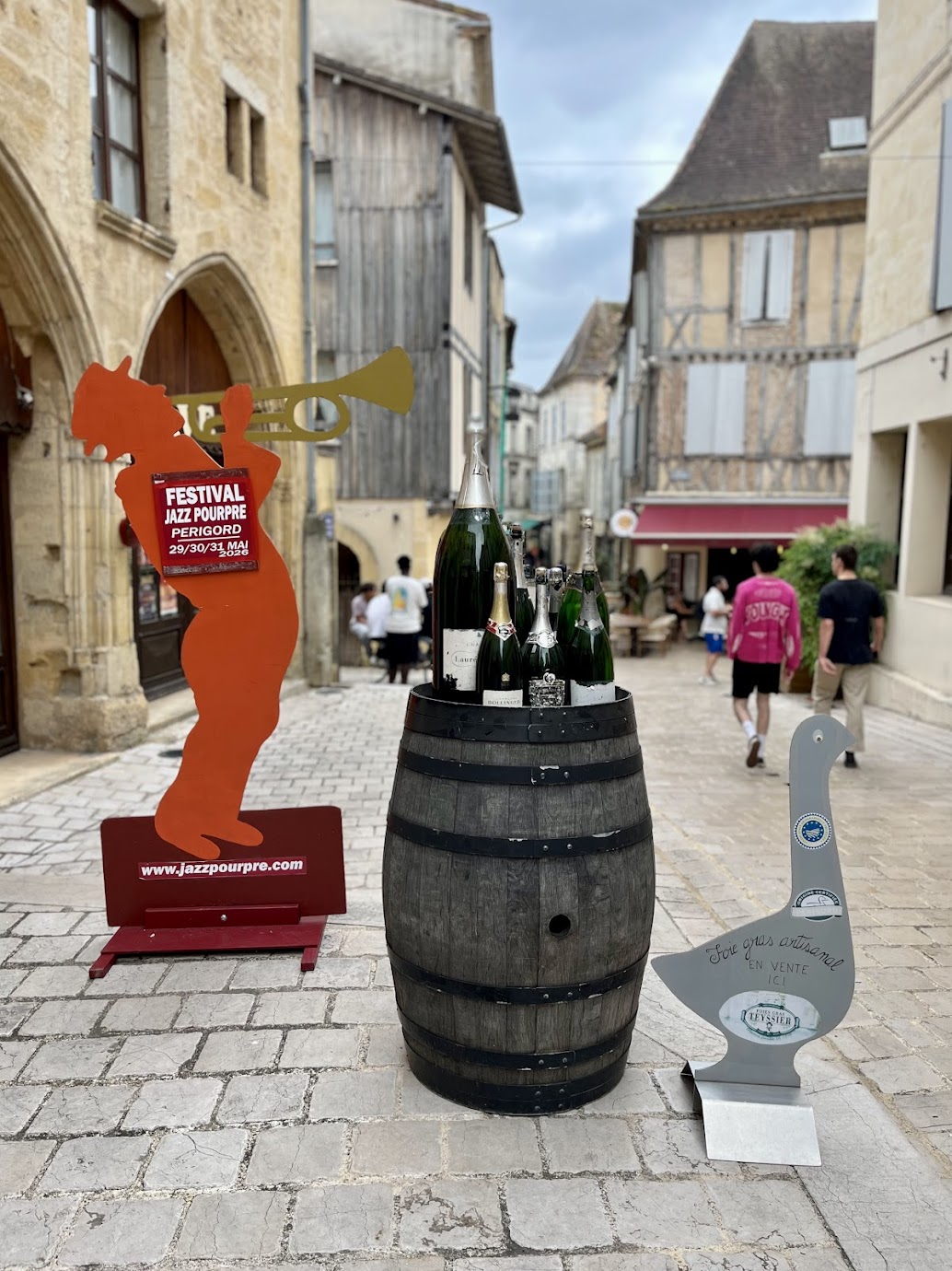
However, the Bordeaux region noticed the exports passing through, and according to my new friend, they invested in and developed their own vineyards, then stopped Bergerac’s shipments on the Dordogne and insisted that the Bordeaux wines be exported instead. So we end up with Bordeaux wines being the most famous, centuries on.
The man who was telling me this had lived in Paris for 30 years, even spent a summer working at a camp in Little Rock, Arkansas, and his three children live throughout the world: Bournemouth, Netherlands, Guatemala. But he’s settled in Bergerac and passionate about its history. Likewise, our tour guide Catherine had not been a Bergerac native but was a generous font of local information.
With the lovely Bergerac twinning committee organising transport and meals and even a boat tour on the Dordogne for us, we sometimes wondered what our town on the post-industrial outskirts of the Cotswolds could offer in return.
But as transplants to the area, with no family nearby, we have a lot of experience making it a place worth visiting. Whenever family do come to see us, we find a fair bit to do around here.
We hugely value the local knowledge guarded by those who’ve spent much of their lives here. We may have a fresh appreciation for how it all presents itself, though.
On Our Doorstep
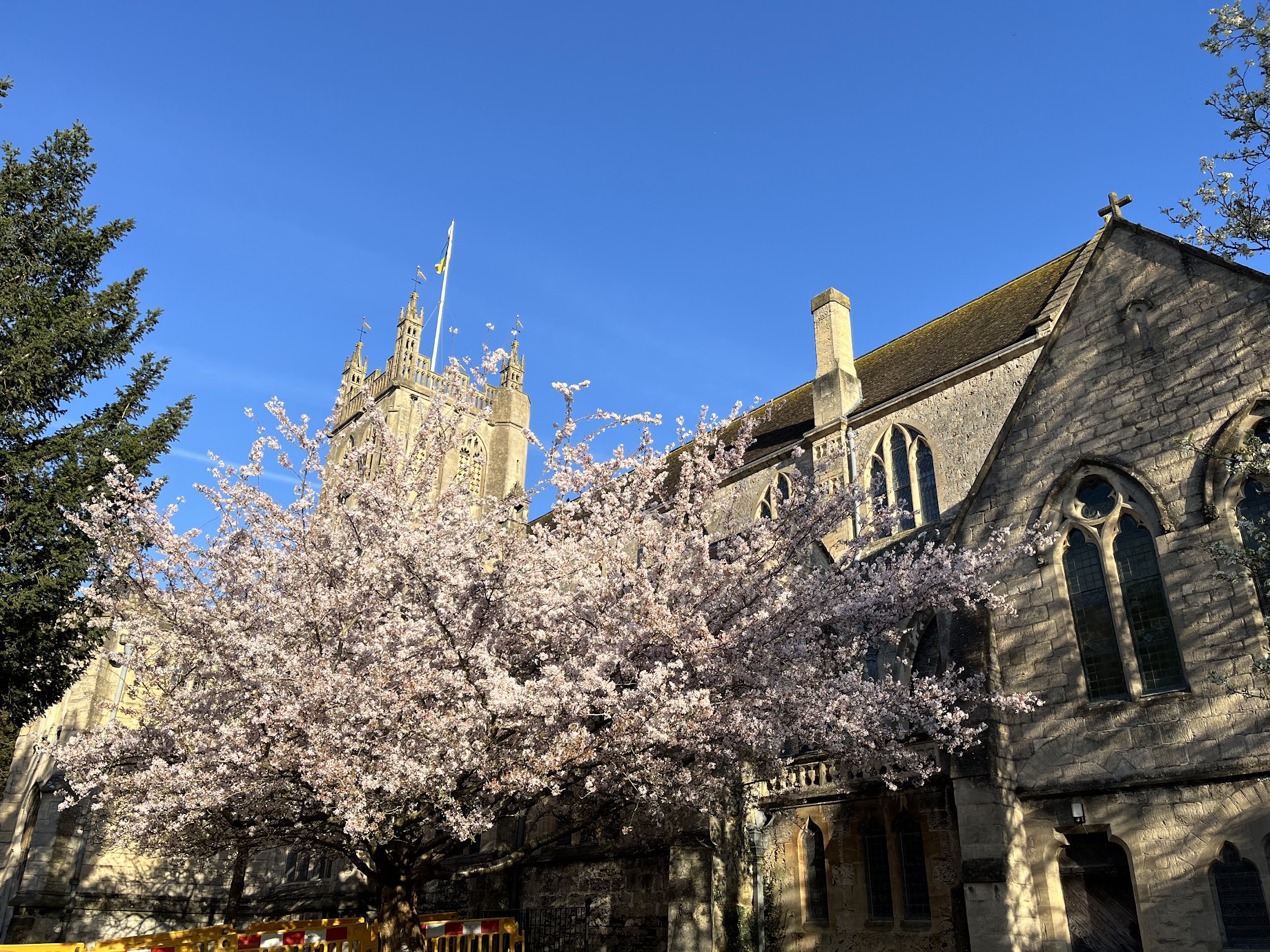
Our town is only one-quarter the size of Bergerac. We too have a central church called St. James, dating back to the 15th century. It was the site of some carnage in 1698 when the steeple collapsed, and the bellringers inside were killed. Now, it hosts a free book fair on Saturday mornings. Behind it, there are a couple trees which are stunning in springtime with an unparalleled froth of blossoms, and further along there’s a little system of alleys entangled with a small water channel.
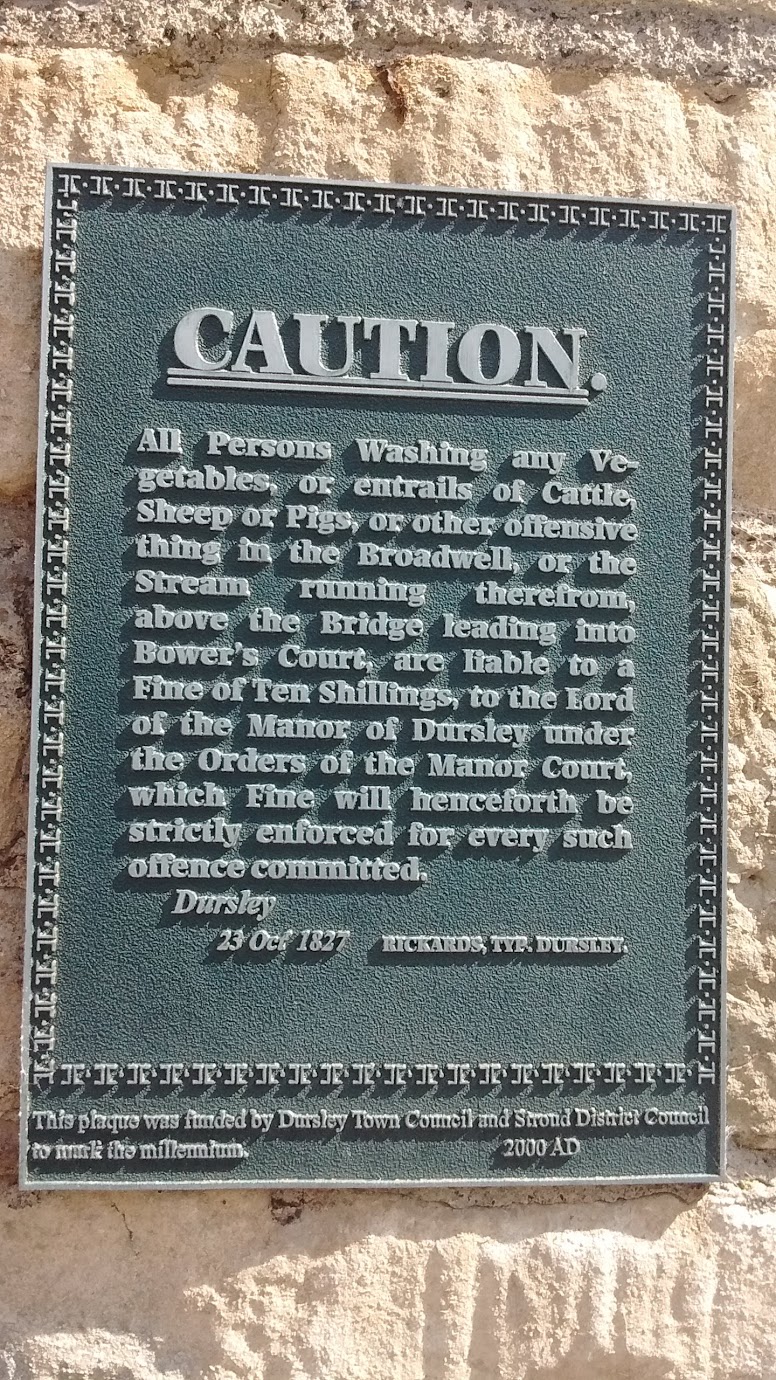
Bergerac has a much bigger knot of medieval alleyways, but I do love the little stone arches in Dursley. And I don’t think Bergerac still displays a 19th-century sign instructing townspeople not to wash offal or entrails in the spring. Dursley has, thank you very much.
Our town used to be the site of a massive engine factory. A minor work of literature was based in this factory, like a Kafkaesque version of Sinclair’s The Jungle. Peter C. Brown worked in the Lister factory when he wrote Smallcreep’s Day, about a bored employee who explores his workplace and finds all sorts of surreal happenings.
We used to have a Smallcreep Street named after the character. It’s a fantastic character name, isn’t it? If I were giving a tour, I’d definitely include that.
What stories do you know about where you live, and how did you find out about them?