The Wow Factor

This Week’s Bit of String: First fireworks

When my little Bear was 2.5 years old, my best friend and I took them to the 4th of July fireworks in the biggest local town. The Outing Club rocketed the fireworks from their ski slope over the surrounding valley, and we were running late as ever so were just trotting down the opposite hill when they started.

The colourful explosions put a skip into Bear’s step. They cried, “Wow! Oh, wow!”

I don’t think I’d ever heard them say that before. Such excitement is to be cherished and never forgotten, and fully warrants the nearly-taboo exclamation points.

Like the time after school once, a few years later when we were settled in the UK. Bear and I were walking back from town, they were maybe 6 years old, and a harvest moon rose, big and yellow. Bear stopped in the middle of recounting some kind of ds game or Star Wars scene to me, and broke into applause for the glorious natural phenomenon.
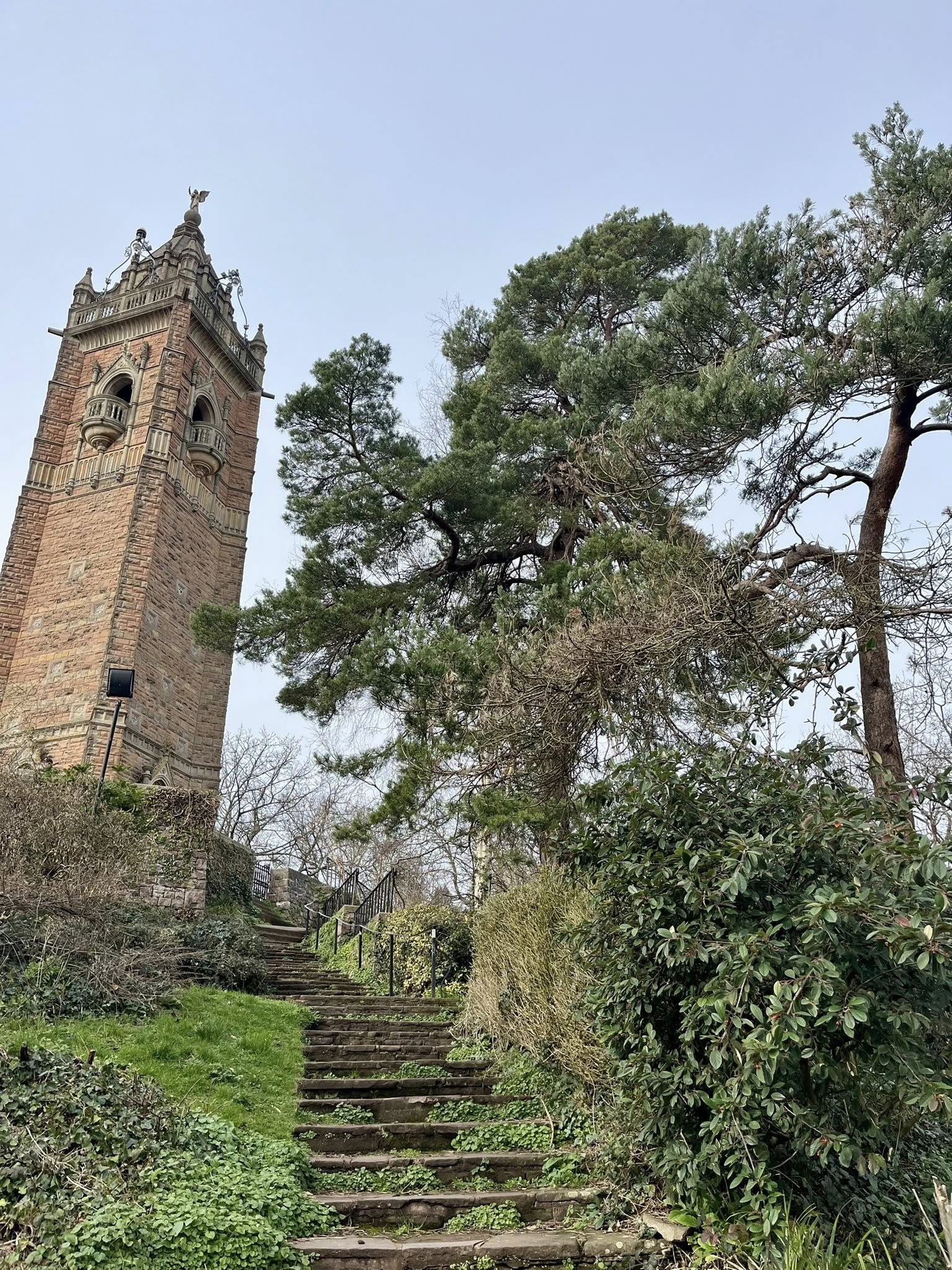
Cabot Tower on Brandon Hill, Bristol

It’s so important to put ourselves in the way of moments that produce this type of reaction, even if it’s a daily event like the moonrise. We mustn’t lose our capacity to be impressed.

During half-term this week, I’ve mostly been working on writing and reading and weeding and cleaning. But I did abscond for a day and take the train to Bristol for a good wander. I climbed Brandon Hill and Cabot Tower to look out over the city, had a roasted white hot chocolate from Mrs. Potts chocolate house, and mooched around Bristol Museum and Art Gallery. Plenty of Wow Factor there, from Assyrian tablets to ichthyosaur bones to all kinds of crystals and then more paintings and artefacts.

I could have stood for ages in front of James Tissot’s oil painting Les Adiuex (The Farewells) from 1871. The detail of the woman’s lace gloves! The clasped hands and the faces agonised by separation. But, there were other gallery visitors and it’s only fair they should see the painting as well.

Vacationing

When I was out and about in Bristol, there were lots of families trying to keep entertained there. Two siblings behind me on the train really liked the Arriva Train Care centre near Temple Meads station, with its sidings flanked by giant car wash brushes.

“That is so cool,” they kept saying.

And as I wandered at Bristol Harbour, I heard excited young people mistake the boats for the Titanic. At Millennium Square a boy on a scooter, maybe already in the early years of secondary school, freely told his friend, “I love these fountains.”

I’d almost forgotten what it’s like to hear kids enjoy themselves. At work we’re becoming pretty rundown. The students are so unmotivated and in a few cases, unpleasant. That said, my experience is mostly within the special needs area. Many of our students truly struggle, and exams ask almost too much from them.
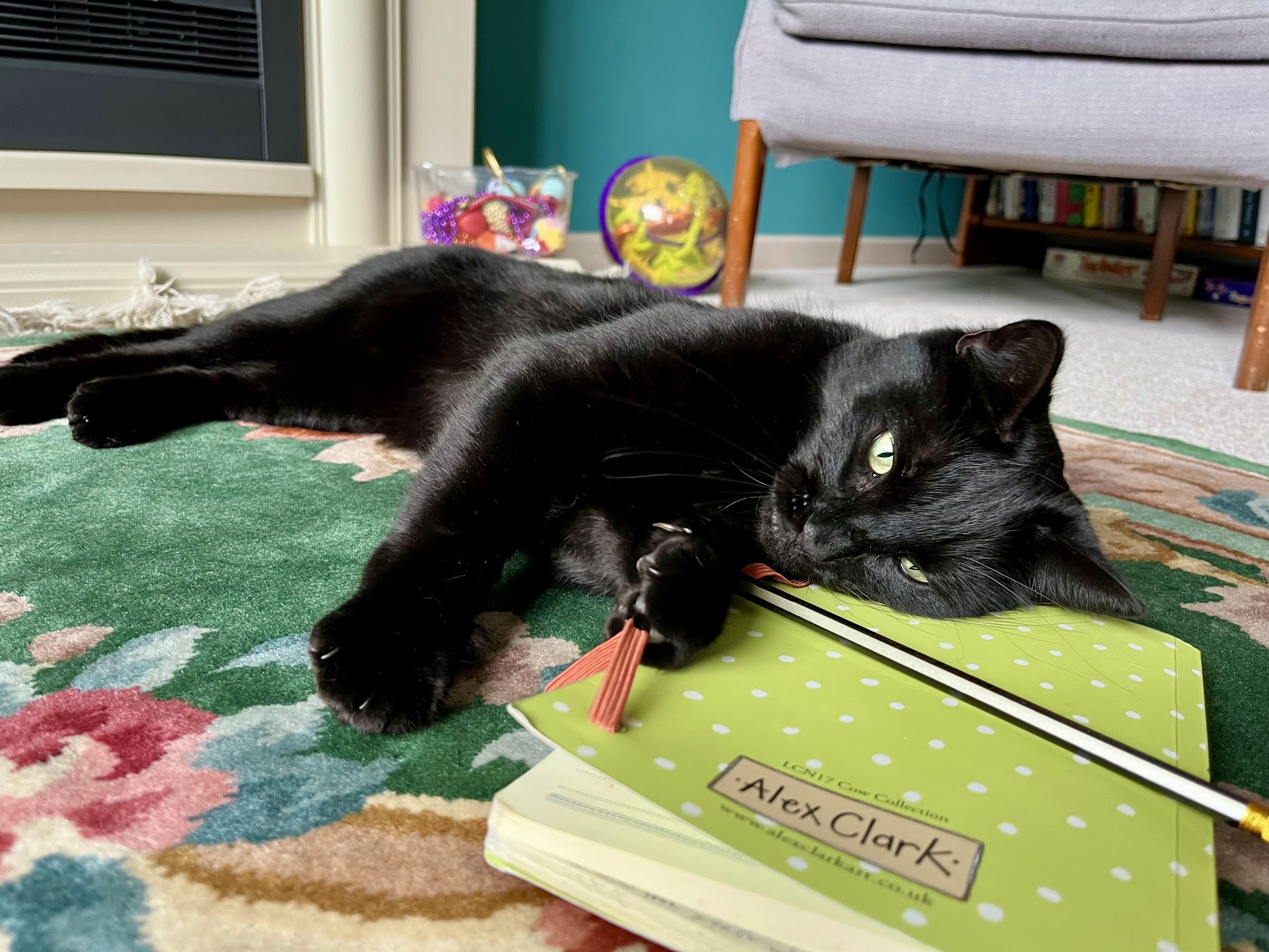
Obie, however, is ready to try being a writer and a scholar.

Other students will experience school differently. On the last day before the break, quite a few of our statemented kids were out (there’s one boy in Year 10 who is marked “ill” on the last day of every single term—intriguing, no?) so I ended up in a top-set year 10 English class.

They were reviewing GCSE war poems they first learned last year, so I took a small group to go over “Kamikaze” by Beatrice Garland. It tells the story of a Japanese pilot who was supposed to commit kamikaze. But he changes his mind, and goes home instead. He chooses life, and his family can never forgive him. His neighbours and his wife, ultimately his children, refuse to speak to him again because of this dishonour.

I read the poem to a group of 4 students I’d never met. The last lines go: “And sometimes, she said, he must have wondered/ which had been the better way to die.”

The boy next to me said, “Wow. That was really—wow. You know?”

Rejuvenation

It’s just nice to share that reaction sometimes.

Although I always have some kind of deadlines and a long to-do list, the half-term week off from my day job at school is lovely because I can do it all with a bit less rush. I can pretend that writing is my main work.
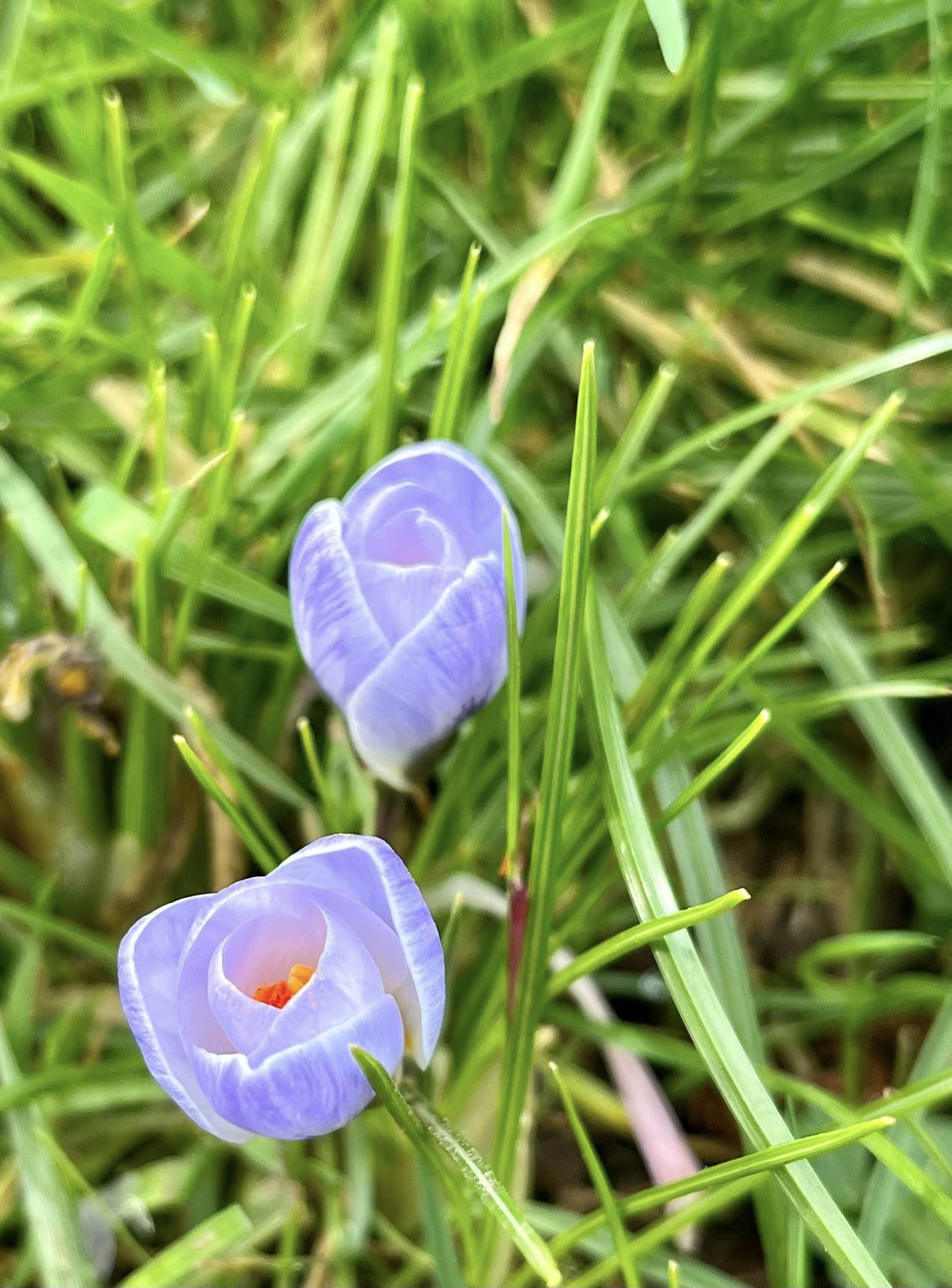
It’s like they’re glowing!

Sometimes, a lack of spare time can make us more productive. We are aware of our limits so we optimise any opportunity to write. A sudden extra helping of free time, as at half-term, might make us more reckless and we squander some of that time. There’s truth in that.

On the other hand, not being rushed can give us some creative freedom. I might enjoy writing more when I don’t have a million other chores hanging over my head, just as those poor kids on half-term can go out and enjoy themselves.

And maybe, when we all return to school tomorrow, those of us who sought and were privileged to find inspiration will have some new energy and tolerance so we can keep trying to pass it on. When I climbed Brandon Hill in Bristol, the views from the tower were pretty great, but so too were the crocuses close to the ground. It reminded me there’s excitement and beauty to be found all over—maybe we just need a little break.

What makes you say “Wow?”
2025 Reading Round-Up

With minimal ado, here are my favourite books out of all I read this year. These are truly the 10 best of my best, because there were a few more which I rated with the full 5 stars.

What were your favourite reads this year? Have you read any of these books yet? I know I’m a bit late to the party on some, and I’d love to hear what you thought if you read some of these before.

The Women by Kristin Hannah

An epic tale of an Army nurse in the Vietnam War. She also has to cope with re-entering civilian life, particularly challenging with her upper-class family. They serve as a contrast to the strong, unconditional friendships she formed with other Army nurses. Truly an eye-opening read.

“Time and friendship had done exactly as promised: pain and grief had grown soft and malleable in her hands, almost pliable.”

Cosy festive reading corner

The Lives of the Dead by Fiona McKay

I joined a book group specifically reading novellas-in-flash. It’s been exciting to explore, and I found this one particularly powerful. Each very short chapter is a mini-story, alternating between episodes in a new wife/ mum’s suffocating life, and stunningly retold fairy tales.

“It’s the kindness that does her in, that releases her long-held tears, that leaves her to walk back, red-eyed, along the line of women when she’s done; kindness, the essential vitamin missing from her supplements, the one she didn’t know she was lacking.”

Anxious People by Fredrik Backman

I love ensemble pieces, where a quirky range of characters are thrown together. In this case, it’s at an apartment viewing which then goes wrong due to a desperate, bungled burglary. It’s funny and warm, the sort of thing to help survive a Scandinavian-level winter.

“Our hearts are bars of soap that we keep losing hold of; the moment we relax, they drift off and fall in love and get broken.”

Love lay down beside me and we wept by Helen Murray Taylor

I know Helen from the Women Writers Network, so I have been looking forward to her mental health memoir for years. She focuses on when she was sectioned in Glasgow following a breakdown. Helen reveals the contradictions we might hold in our minds at our lowest point and still she invites you in with humour.

“Trying to describe love was like trying to stroke Schrodinger’s cat.”

The Given Day by Dennis Lehane

I love Lehane’s books, especially his snappy dialogue. This novel is set in Boston just after WWI and deals with racism, poverty, immigration, labour rights, and even the tragedy of the Boston Molasses flood. It made me appreciate that the USA has come through incredibly tense times before, and we may yet make it.

“Have you got Winnie-the-Pooh?”

“Time and again what was renounced as treasonous was merely a man standing before a crowd and demanding he be treated as a man.”

Orbital by Samantha Harvey

Short and searingly beautiful, this Booker Prize winner is a wondrous read. It takes us through one day in the lives of six astronauts on the International Space Station, describing the many juxtapositions of what they see below on their various orbiting paths, and lyrically weaves in the astronauts’ backgrounds and aspirations.

“He has an idea that if you could get far enough away from the earth you’d be able to understand it—to see it with your own eyes as an object, a small blue dot, a cosmic and mysterious thing. Not to understand its mystery, but to understand it is mysterious. To see it as a mathematical swarm. To see the solidity fall away from it.”

All the Light We Cannot See by Anthony Doerr

A great book about totalitarianism and war, with breathtaking depth of character. Both protagonists were so incredibly rich in background and passion for their interests, Marie-Laure with her Verne books and her understanding of how to get around without her sight, Werner and his machines and radios.

“She feels the great granite fist, sunk deep into the earth’s crust, on which Saint-Malo sits, and the ocean teething at it from all four sides…She hears the bones of dead whales stir the leagues below, their marrow offering a century of food for cities of creatures who will live their whole lives and never once see a photon sent from the sun.”

Home Bird by Fran Hill

A reading verandah! Found on a walk in small town New Hampshire.

If you’ve read Fran’s Substack–and you really should–you’ll know she excels at writing humour. But I love her detail selection even more. Her plots advance quickly through the specifics her narrator includes, bringing out the nuances of relationships and recreating the period of her novels. 

“She knocked on my door, saying, ‘There’s Bakewell tart going spare,’ but I said, ‘It’s not the only one,’ and she left me alone.”
 
Still Life by Sarah Winman

A true feast of a book, celebrating art and travel and food but most of all friendship, the abiding kind that’s more like true love. After World War II, an unlikely band of Londoners, united only by happening to drink at the same pub, move to Florence and discover worlds both old and new.

“‘We’re embarking on a world of new language and new systems. A world of stares and misunderstandings and humiliations and we’ll feel every single one of them, boy. But we mustn’t let our inability to know what’s what diminish us. Because it’ll try. We have to remain curious and open.’”

Tomorrow and Tomorrow and Tomorrow by Gabrielle Zevin

This book is about the creative process, relationships, grief, negotiating differences in ethnicity and sexuality… oh, and videogames. I loved it so much. The section about the NPC (non-playable character) is the most gorgeous and heartbreaking that I have ever read. 

“Memory, you realised long ago, is a game that a healthy-brained person can play all the time, and the game of memory is won or lost on one criterion: Do you leave the formation of memories to happenstance, or do you decide to remember?”

Finding a Door

This Week’s Bit of String: A dark and stormy night

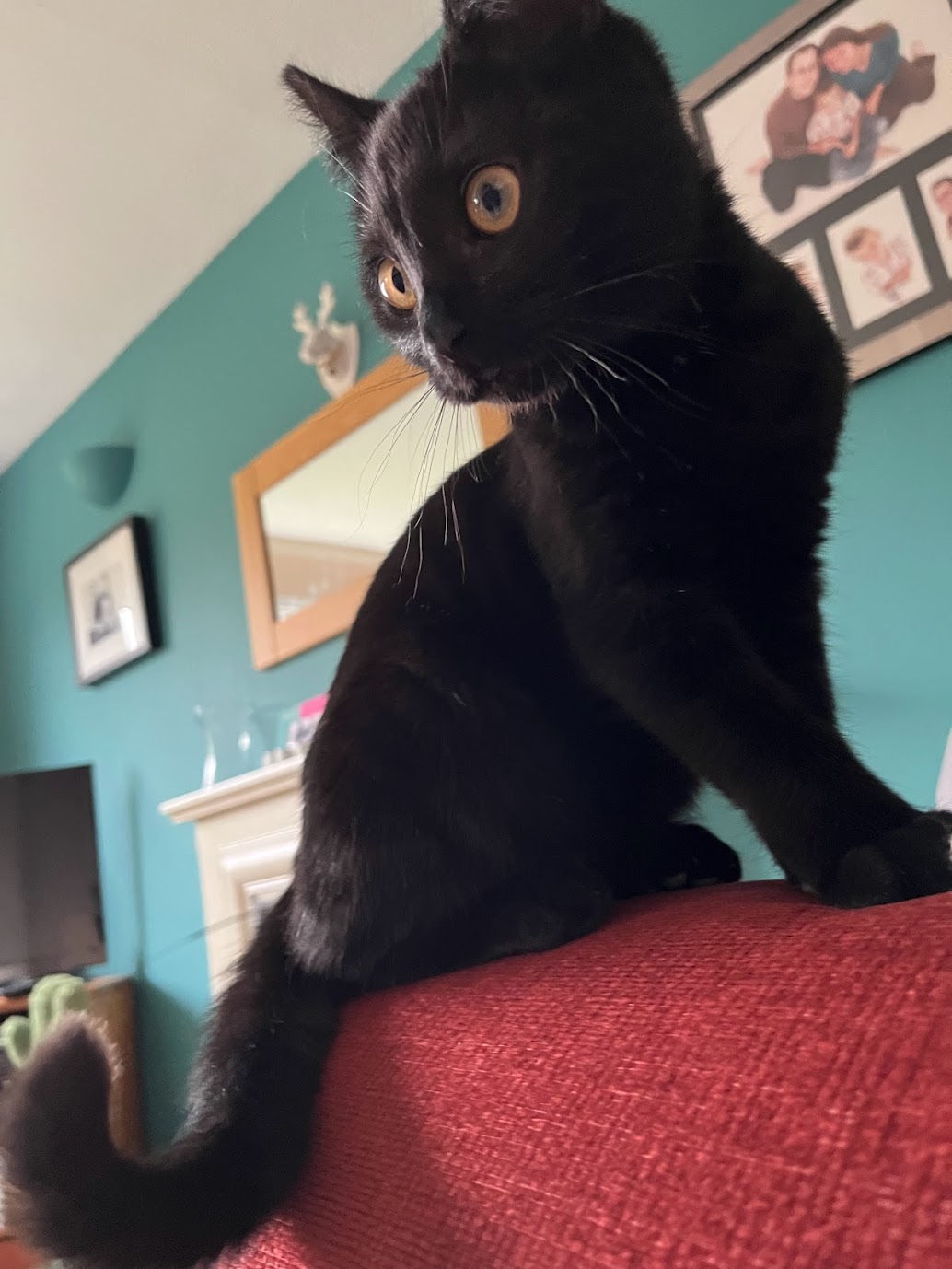
One rainy evening out of several rainy evenings this week, our cat Oberon got restless. He was hanging around the hallway, so I opened the front door in case he wanted to go out.

It’s all a bit much when you’re a small scaredy cat.

Named for the prince of the fairies, Obie does have a microchip-activated catflap in our double-glazed back door. It’s complete with fixed metal platforms in and outside the door for him to step up to the opening and then down, most daintily. Whenever possible, though, he naturally prefers a door to be opened for him.

When I opened the front door that night, exposing the wind and rain, Obie hissed immediately. That’s a no, then.

He lives in hope that the front door, actually at the driveway side of our semi-detached house, will reveal a different world from the one he sees out the back door into the garden, or the front windows onto the front garden and the cul-de-sac.

For us humans, opening our own front door rarely brings surprises. We expect most deliveries and don’t receive many guests. With Remembrance Day just passed, I consider the days when a knock at the door could bring devastating news. Now we have much tinier rectangles that do that for us.

Story Portals

Last Saturday, before the sun retired into indefinite hibernation, I spent the day wandering around Stroud for the Book Festival there. I went to Alice Jolly’s book launch for her new novel, The Matchbox Girl. It sounds excellent, a story told by an imagined adolescent neurodivergent girl who collects matchboxes and spends time in the Vienna Children’s Hospital, where she gets to know Dr. Asperger.

Jolly told us about the Children’s Hospital, and its workers who resisted categorising children, viewed each patient as gifted, and simply believed the deficiency lay in adults who hadn’t learned to understand a child’s differences yet.

Mock exams started this week for my poor SEN students, so let me tell you, that sounds pretty awesome.

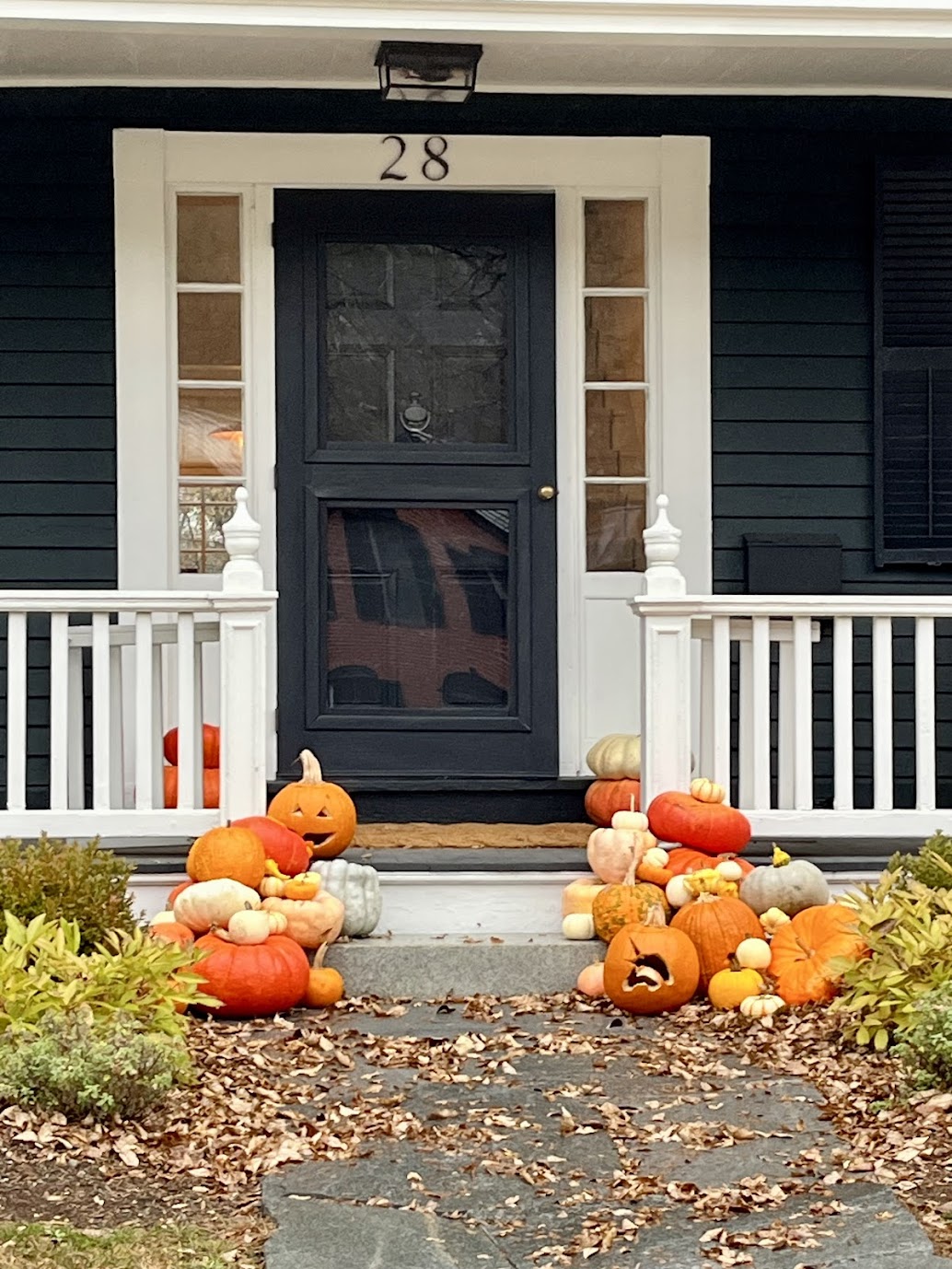
Seasonal front door reflections, Woodstock, Vermont

Unfortunately, The Matchbox Girl is set in 1934 and the ensuing years. So, things didn’t go so well in the lovely Vienna Children’s Hospital after a while. Dr. Asperger was revealed in this century to have collaborated disastrously with the Nazis.

Jolly explained that she was researching Dr. Asperger and the hospital, but didn’t know how to write a novel about it all until she had the idea of the matchbox-collecting Adelheid.

She said, “When writing a novel, you must never go in through the front door. You must find a way in the back.”

This edict pierced me. I’m always seeking to improve my craft and when a talented writer, who teaches Creative Writing at Oxford no less, issues a proclamation about how stories work, I immediately inventory everything I ever wrote. I suspect I’m not the only one?

Anyway, I was thinking, “What is the front door to each of my individual projects, and which is the back? Have I been heavy-handed and just crashed through the front, is that my problem? Why don’t I immediately understand what my novel’s front door is, is that my problem?”

Head and Heart

I meant to submit my novel The Gospel of Eve to more publishers and agents this year. But I was wrapping up an edit and more dauntingly, a synopsis rewrite, when I became so busy with critiques and a new project and work and family, I sort of forgot. That’s a major goal for 2026.

But Eve in herself is like a pre-fabricated back door, isn’t she, relegated as such for millennia? In my new project, I suppose the front door is the whole relentless mess of trying to appear good, while the back door is the comparatively straightforward (but still quite messy) task of fixing up a New England resort and cabins. Each banging cottage door reveals not just the renovations needed inside, but further internal turmoil for the new owners resulting from past relationships.

An evening in Stroud

While at Stroud Book Festival, I also attended an interview with Elif Shafak regarding her latest novel, There are Rivers in the Sky. I’m excited to read this book as well. It spans history through a single drop of rain and incorporates the epic Gilgamesh poem.

Elif Shafak is passionate and graceful, and she spoke about the difference between information, which we have in overabundance; knowledge, which requires sustained commitment; and wisdom, which engages the heart.

I don’t want to worry so much about front doors and back doors and such, so that the heart of my project goes the way of the sun recently, obscured by my deluge of thoughts. It’s been such a long time since I actually started writing a novel from scratch—my Eve novel started as a short story—that I’m constantly questioning myself. Were my previous drafts this rough?

But after receiving very positive feedback about the first 3000 words, I started to feel better. It takes time to find a story’s heart, front door, and back door. Now that I know someone wants to read more, that gives me strength to keep discovering.

Have you been to any literature festivals this year? What great books have you discovered, and what insights did you gain into your own creative work?

Weighing Ideas

This Week’s Bit of String: Notre Dame towers and a dog called Unity

Last weekend, we were in Paris. It was a wild idea, the trip planned in less than a fortnight. From 3:00 Saturday morning, when we woke up to shower and catch a flight from Bristol to Paris CDG, until 10:15 Sunday night when we fell into bed back in our own home, we walked 54,000 steps. We stayed Saturday night in a tiny hotel room in the 14th Arondissement, but the bed was comfortable, we had climate control, and there was a full Parisian breakfast included.

We had a bittersweet reason for this enjoyable adventure. When my aunt Laurel died a couple weeks ago, one of my cousins already had a trip booked to Paris. Laurel and my cousin were great Francophiles, so the family was inspired to send some of her ashes over and scatter them in the Seine. I couldn’t be at the full funeral in Vermont–busy though the weekend in Paris was, it didn’t shatter me the way a whirlwind cross-Atlantic trip with a minimum of 16 hours travel each way would have done–I could be part of this goodbye without missing work. 

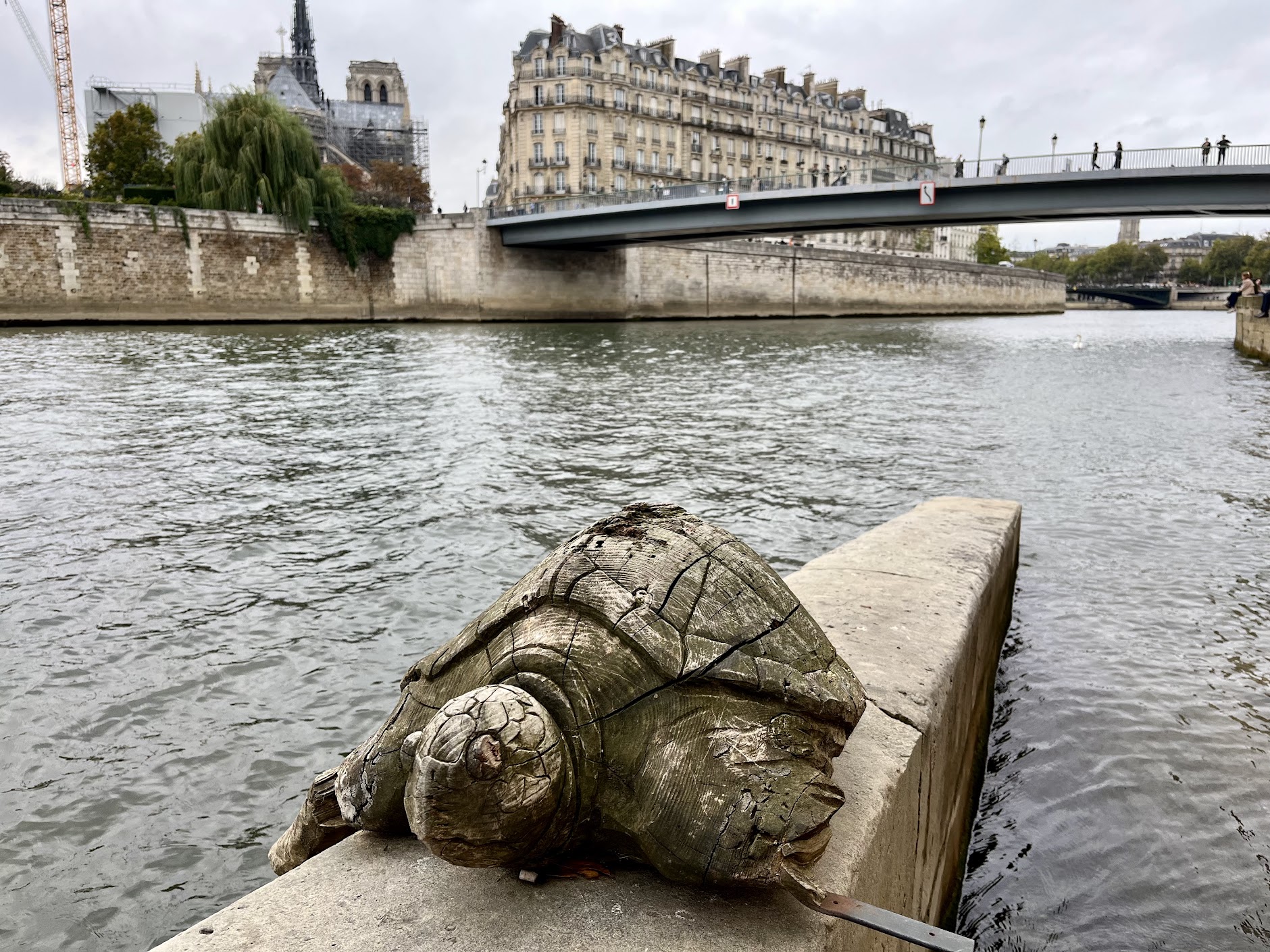
My cousin chose a spot across from Notre Dame’s dome, where we could walk down a cobbled ramp to the river. We found as we approached that as well as a cathedral view, we would be leaving my aunt alongside a weathered wooden statue of a turtle bracketed onto the stone wall, quite fitting as she’d had a beloved pet turtle for decades. 

She loved dogs too, and soon after we’d poured her ashes into the river, a dog came bounding in, bucking jubilantly, snapping at her own splashes. Her French owner told us the dog’s name was Unity, and we did feel a strange synthesis at the resting place. 

I was happy with this sendoff for Laurel, but my heart aches that all the life erupting around her in this location will never know her or her story. I wonder what other remnants of lives we step over all the time, and what unimaginable events will unfold later.

Interlocking Stories

Paris is particularly suited to such wonderings, with its many plaques honouring students and others who were killed in the Resistance against Nazi occupiers, and other signs memorialising Jewish families that were deported. Behind Notre Dame, there’s the Memorial to the Martyrs of the Deportation, which I researched for part of a story I wrote in January. The main character spent time in Paris and met his fiance, changing his life.

I certainly didn’t imagine I’d be visiting Paris later, and scattering my aunt’s ashes across the Seine from the same Memorial. Once again, there’s a strange unity of past and present, fiction and nonfiction. As Julia Ormond says in the 1990s remake of Sabrina, one of my aunt’s “Chicken Soup Movies” which she believed had restorative powers: “Paris is always a good idea.”

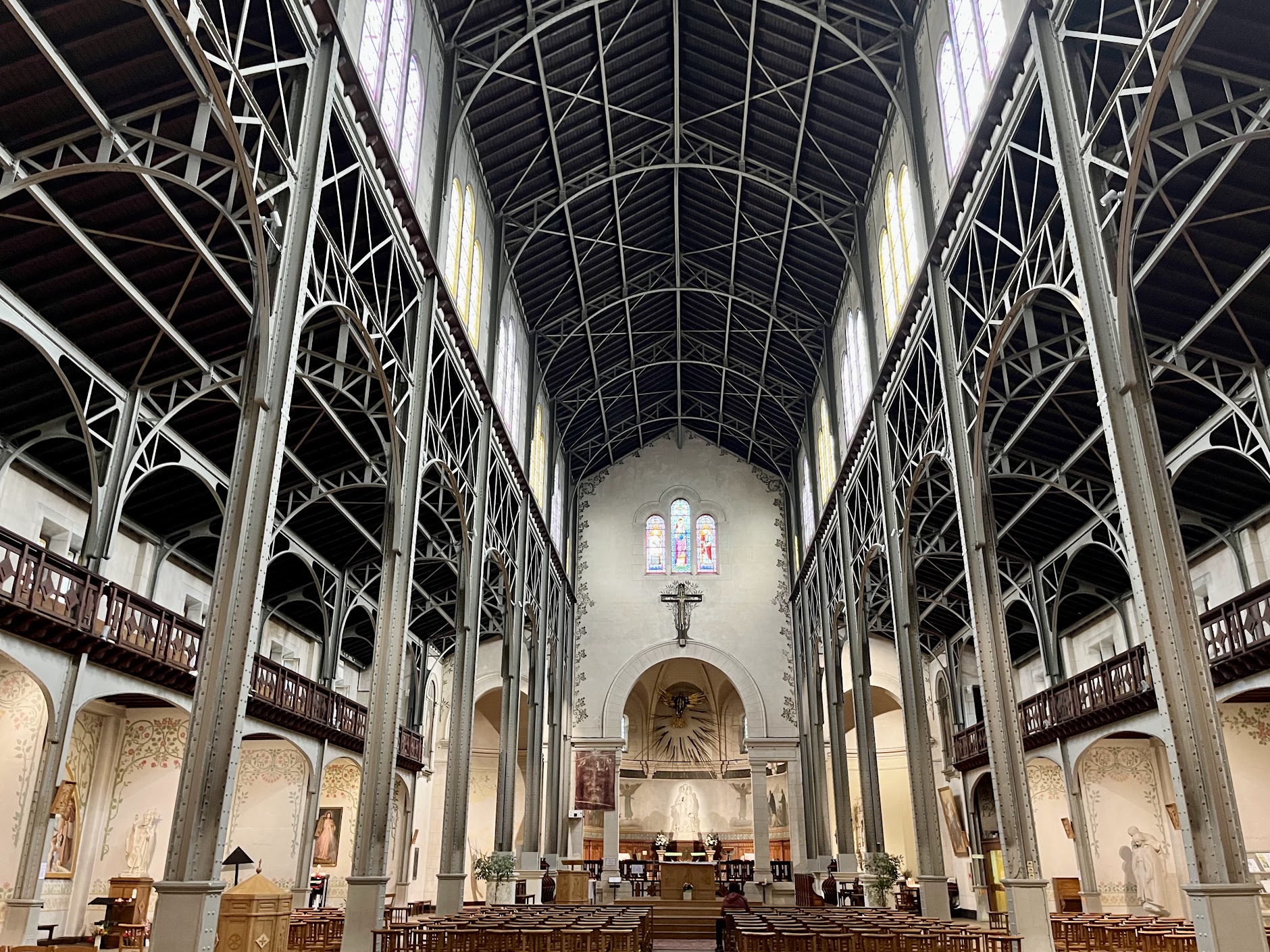
Back to the writing work, here’s a picture of the incredible Our Lady of the Workers church in the 14th Arondissement

I’d actually forgotten about the story I wrote in January, with its Paris turning point, until my cousin told me where we’d take our aunt’s ashes. The story needs a lot of work. I wrote it during my January short story binge, when I slapped whatever idea I had onto paper: new ones, old and previously rejected ones, half-dreamed ones. 

Since then, I’ve had a couple short stories I’ve worked hard at polishing, and I’ve started a new novel while still working on the final edits to my book about Eve and Creation. These projects are still keeping me pretty busy alongside my day job and everything else, so the fictional Paris encounter will probably wait a long while.

Ideas to Remember

It’s not possible to remember every idea or story, good or bad. So just because one thing has to wait doesn’t mean it will never get its time. When it comes to assessing our creative choices–and our life choices, really–there are so many possibilities that it seems unfair to judge one as entirely bad or good.

While I’m making up a new novel, I haven’t decided yet whose voice to lead with out of my new characters, and I keep switching. Would 5 points-of-view be too many? Yes, I know. But I decided while making myself write just four days after Laurel’s death, my work-in-progress wasn’t fun enough. So I pried its bars loose, and went back to page 2 to introduce an entirely new character, outside the pages of development I’d explored and planned in the pre-drafting stages. 

Have you ever felt the need to do such a thing? Did it work?

My middle-class protagonists who take themselves somewhat seriously needed a foil, or maybe that was just me. Either way, I’ll see what comes of having someone else in the mix. A story undergoes so much evolution and so many rewrites, most ideas turn out to contribute something worthwhile.

I wouldn’t usually slide in an extra character, but it’s earlyish still, and who’s to stop me? In real life, there are people who appear out of nowhere and brighten everything. 

I wouldn’t usually spend a middle-of-the-term weekend gallivanting around Paris, either. I don’t know if Paris, is, in fact, always a good idea, but it worked for us this time. And there’s a lot more we’d like to see. Strange to think I now have a bit of my aunt on this side of the ocean, over the Channel. Wondrous to imagine the places and people we have yet to be part of.

All in Your Head

This Week’s Bit of String: A 160-year-old murder

Once on a Girl Scout visit to the local Shaker Museum, we learned about a murder which hastened the decline of this hard-working populace. The story stayed with me for decades, and only recently on a visit home did I confirm it.

Shakers, officially the United Society of Believers in Christ’s Second Coming, fused work and worship to delight in tasks rather than view them as punishments. This resulted in some excellent craftsmanship for which they’re known. They’re also distinct for practising celibacy. Their numbers relied on recruits.

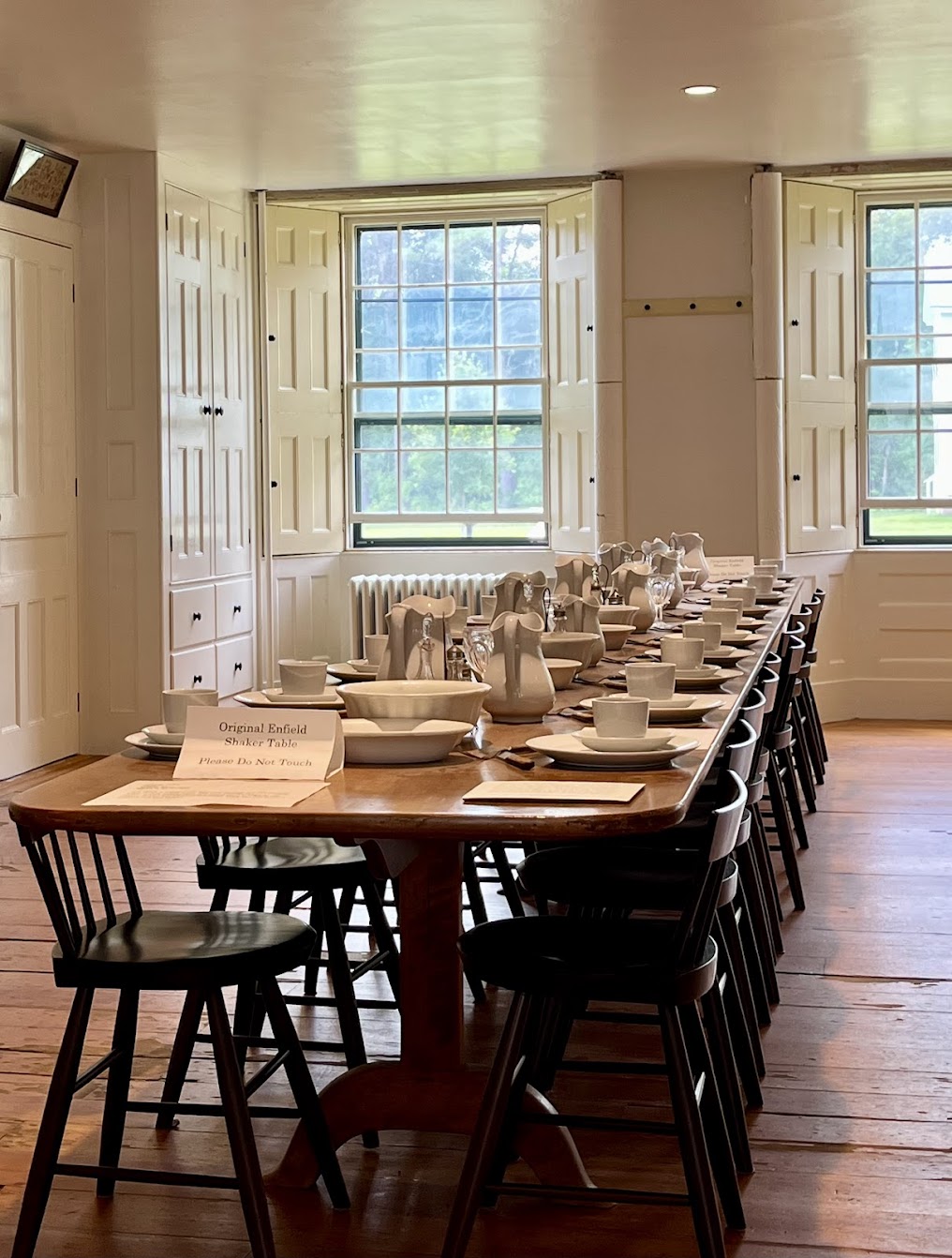
One of the original Shaker tables, where the Wier girls may have eaten their meals

Families struggling to provide for their children might sign a couple over to the Shakers, agreeing not to interfere with Shaker education. When the American Civil War started, a man named Thomas Wier entered two daughters into such an agreement. He was enlisting, and his wife was ill. It seemed the best way to look after them.

In 1863, Wier returned. He made various attempts to take his daughters back, valuing unification above the contract. His wife and older daughter tried to snatch them away during a visit, but the girls fought them. On another evening, Wier tried to visit them but the community trustee, Caleb Dyer, refused because it was so late in the day. Wier shot him.

Caleb Dyer died from his wounds three days later. As trustee, he’d been in charge of the finances pooled by the fellowship. They had invested in mills, bridges, and railways around town. However, his records of these transactions had mainly been mental and unwritten. Without him, creditors swarmed and a local mill even, apparently, fabricated debts and demanded them of the Shakers. The community lost a lot of money.

Hearing that story the first time, it fascinated me that a whole group’s fate hinged on a desperate man’s impulsive act against a seemingly, perhaps excessively, introspective one. I always wondered what happened to the children Wier was pursuing. Did they feel responsible? Where did they truly feel at home?

My recent visit did not illuminate anything on that front, so I’m still imagining the possibilities.

Life of the Mind

The tale had populated my mind for so long anyhow. In my last post, I considered how random objects can lodge in our memories, and this is even more true of stories. Their crest and ebb etch channels into our minds. For us creative types, it’s as if we’re standing on the shore wondering how to harness these tides.

How far will our creations make it?

Once we’ve diverted our gathered stories into new forms, an even bigger question is: What’s good enough to share? Which are better off eddying in our minds and which can we release?

Last week, one of my stories dried up in the wild, you might say. It was my third story to flow all the way to a major competition’s longlist, but not make it past the dam. Longlisting is good for sure, but I want better for my stories. Now I have to work out how to give it an extra shove, when I thought it was great already.

It’s panic-inducing, the realisation that most of our work will advance no further than the borders of our minds. Our desires to reap tangible benefits from all our efforts, to gain recognition and to be remembered for it after we’re gone, are all real and human. If my novels and more of my stories never get published, will all my time be wasted?

Shifting Currents

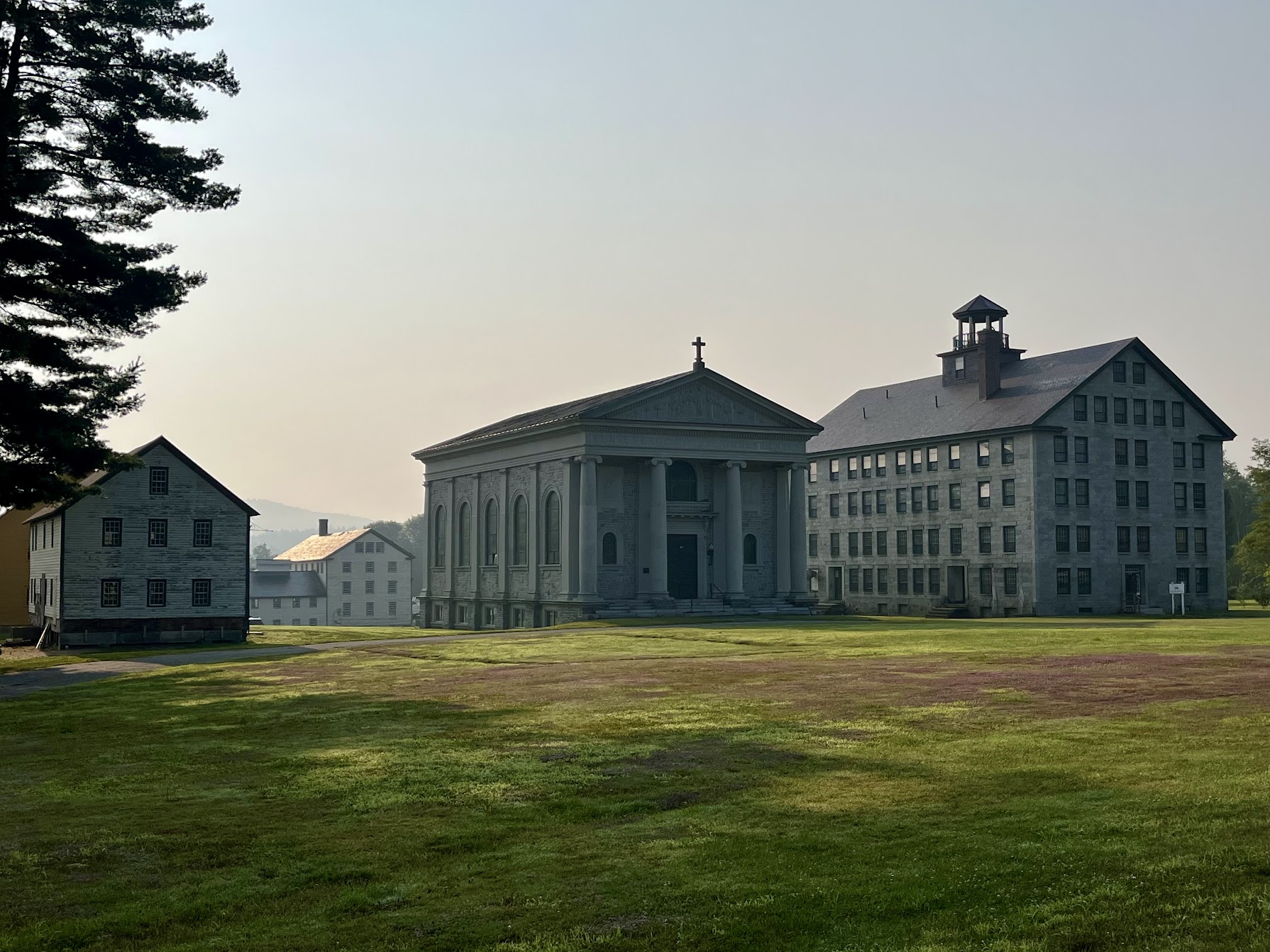
When the Shaker community started to die down and sell off their buildings, a Catholic community bought up much of the premises. They built their own shrine and chapel, and fixed up the Shaker buildings with a view to running a boys’ school.

From left: Shaker broom shop, Catholic chapel, Shaker Great Stone Dwelling

For decades the shrine kept going partly by putting up a dazzling display of Christmas lights in the snow, and receiving donations. But the funds seem to have dried up, and as of a few years ago, they couldn’t maintain the site. By this time, the Shaker Museum was established enough to buy the site back.

So, anything can happen. A draft of a story in my head could evolve into something else entirely, or get swallowed into another project. Maybe that will have more of a chance outside my imagination’s borders. Who knows.

Like the Shakers, we can’t view our work as a punishment, or even exclusively as a means to an end. Engaging with creative pursuits is challenging, but it helps us make sense of and appreciate our surroundings and the people therein. It gives us an outlet in stressful times, whether someone else ever sees it or not.

Even if our creations don’t make it far out of our heads, is that really such a bad place to be?

Dreaming Spires

This Week’s Bite of String: Noise in an Oxford museum

While I was admiring Japanese cloisonné vases in the Ashmolean this half-term week, a family came along. They had a couple of primary school-aged girls shining cheap little laser torches everywhere. The slightly older of the two girls was quietly singing to herself, but the other was shouting and running around.

“Beatrice!” her parents kept saying in upper middle class tones, ever surprised at unconventional behaviour. “Beatrice, you’re getting silly… Beatrice, we’re in a museum. It can be quiet and peaceful…”

“It CAN be quiet and peaceful,” retorted Beatrice, without slowing down a bit.

Japanese Cloisonne

Gotta love a girl no more than 6 who’s already dismantling arguments on semantic grounds.

The brief clamour enhanced my experience. I was on a solo overnight trip, and spending the afternoon in the massive Ashmolean with only myself to set the pace was a treat. I’d browse a couple of galleries, then sit and scribble about my finds, then repeat. Favourites were the ancient Assyrian and Babylonian exhibits, complementing the several Nimrud temple panels at Dartmouth’s Hood Museum in my home region of New Hampshire, and examples of Islamic and Indian geometric patterns and art.

There are exhibits predating those civilisations, and it inspires me to see how early humans, too, were compelled to preserve and create beauty. Feeding my brain on such exhibits felt rejuvenating, certainly unlike revising for standardised GCSE exams. But feasting on snippets of real life conversations thrills me, too.

Rest and Change

People like to say, “Change is as good as a rest.” It’s not strictly true; I think change enables us to push ourselves further without rest which we may need. Long-term, it’s possibly not of equal restorative value.

A little bit of reading time, Worcester Shrub Hill station

That said, it felt as if changing up my brain’s intake for a day or two rejuvenated me. In addition to visiting the museum, I read Mslexia magazine on the train rides, wandered along the canal in Worcester during a stopover, explored both the busy streets and the tranquil parks of Oxford totalling 43,000 steps in less than 36 hours, and enjoyed a theatre production of Little Women.

Seeing the literary classic on stage was the main purpose of my journey, which I learned about thanks to well-targeted Facebook ads. It was a terrific show, with energy and heart. They made use of birch trees as set pieces, and seeing those made me feel connected to New England from afar.

After the play, I went hunting for ice cream, as is my late-night, post-show wont, and I didn’t go to bed till midnight. But I didn’t leave my hotel for the next day’s explore until 10:30, and that is pretty luxurious for me.

Spending Time Well

So I took a bit of the morning to recuperate, and keep up with my daily scribbles. I have some novel-planning to work on, but I didn’t get to it; didn’t even read much. As usual when I travel, making the most of the experience involves a lot of walking and a fair bit of writing down what I want to remember.

Broad Street, Oxford

Before visiting Oxford, I’d made an effort to put all my new novel work into a Plotting Table, with columns for each character and rows for each chapter. The Plotting Table is super helpful for seeing where stakes may need to be raised for some characters, and so forth. I wanted to print this out and pore over it on paper while out of the house, undistracted by chores.

But our printer is at least 10 years old and is suffering memory loss. It no longer recognises paper. I’ll be poking pages into it and it insists said pages do not exist. Or it will pick up a sheet of paper (or heck, two or three at once), load it an inch, then suffer a fresh bout of amnesia and say it’s out of paper anyway.

I had to give up on printing my Plotting Table. I had nearly 2 miles to walk to the train station, with my rucksack of overnight necessities, and I couldn’t risk missing the train. Turns out I was a bit busy, anyway.

Like Beatrice at the Museum, I would say vacations CAN be quiet and peaceful—but they certainly don’t have to be. Just this once, I think I struck a decent balance.

Have you given your mind any change lately?

Mythology and Me

This Week’s Bit of String: Candles on a motorbike

At nearly 11 pm on Easter Saturday, the taxi driver from Athens airport told me about the seasonal traditions in Greece.

“From the execution Friday until midnight when it turns to Sunday, many people will not hammer, or cut, eat meat, or do anything with violence. It’s out of respect because of the crucifixion.”

Inside the Byzantine Panagia Kapnikarea on Easter Sunday

Then, at midnight, there are fireworks and prayers, before family feasts on Easter Sunday. Freshly arrived in Athens for a city break, my husband and I wandered out at midnight. Down a narrow street we saw the bobbing lights of a candlelit crowd, and we heard the prayers chanted in a nearby Greek Orthodox church. People poured from its marble steps carrying lit tapers—all manner of people: goths, senior citizens… One middle-aged woman came out with a bouquet of 5 lit candles, and climbed behind a man on a motorbike and they rode off.

Not everyone participates, I’m sure. As Iakovos said, “It depends what you desire.”

And of course there’s the other side of the coin, be it Euro or drachma. He told me how much he loves being a driver, especially for tours when he takes people to further ancient sites, such as Delphi or Mount Olympus.

He has particular praise for Mount Olympus. According to him, there’s a spot up there known as the Throne of Zeus, where no wind or snow or rain ever strike, as if it’s divinely protected.

“It makes you think they really knew something,” he says of the ancient Greeks.

Building a Religion

How we interpret such things and act upon them does, as he said earlier, depend on our desire. How often do we believe something we really don’t want to?

When we first learned about Greek myths in school, I was in 8th grade. That’s a lot older than British students learn about them, and maybe for that reason, I did not enjoy the subject. To me, the gods seemed selfish, not to mention cruel and misogynistic. My opinion hasn’t changed much on that, to be honest. I had to read lots of ancient Greek play in high school and college, and I like the genre of modern retellings, but the original stories don’t appeal much to me apart from being cultural references.

Gorgeous weathering on these pillars from Hadrian’s Library

I do think myths have huge value in what they might tell us about the people who believed, maybe even created them. What does it say about people that they would make sacrifices from their own, struggling lives to such seemingly callous deities?

What we found breathtaking in Athens were the monuments made by people. The stunning Propylaea, the Odeon of Herodes Atticus, the Porch of the Maidens alongside the Erechtheion. How incredible that parts of the Pantheon still stand after almost 2500 years of invasions and natural disasters. And the beautiful little Byzantine church the Panagia Kapnikarea, nearly a millennium old. These are marvelous places, designed and built by humans with much toil and cooperation. Yet they make me wonder about a presence even more powerful.

I guess that’s what art can do, inspire you to believe in something greater, even if it’s just a previously unimagined hope for the future.

Likeability Vs Relatability

Looking down at the city of Athens through the Propylaea above, or through the Roman arches behind the Odeon, we had a stunning view over the chaotic crush of buildings, the worn, aged mountains, and the sea beyond. I imagined ancient people coming up here to sacrifice, worship, or be entertained, and wondered what their view was like. Maybe that was enough to keep them worshipping.

Raised in a Christian family myself, we were always deeply attuned to the suffering that Easter springs from, and I like the Greek orthodox idea of acting on that seriousness by refraining from aggressive activities for a couple of days. Maybe my upbringing contributed to my complete horror and aversion of anything execution-related. I am still mystified how Christians sit with the belief that an innocent deity suffered and died for their sins personally, and don’t constantly agonise over that.

Getting the right balance… Porch of the Maidens, Erechtheion, Athens

I once wrote a novel scene between American educators preparing for the 7th grade mythology unit. The Christian teacher describes the Greek gods as “petty and selfish—no better than people.”

On the other hand, he says, “Jesus actually became human, and that’s as accessible as it gets.”

But He never sinned, thinks the teaching assistant. Being human would be a cinch without guilt.

Could it be that ancient Greeks appreciated having dieties with lusts and impulses that reflected their own?

Conveying a religion must be like the constant political tussle over how to best message people. Meet people where they are, or urge them to strive for better? And as writers and creatives, we work to establish that same balance: creating characters who are likeable and also relatable, events that are dramatic and also recognisably everyday. It’s getting that juxtaposition between majestic ancient ruins and the settlements below; the prayers on loudspeaker and the candles on motorbikes. Our ability and taste for this will vary, one might say depending on our desire.

What do you think of the classical myths? Do you find the supernatural accessible?

Enduring Power

This Week’s Bit of String: A pleasant surprise

Sometimes it’s hard to remember in the chilly grey exhaustion of January, but my family had a great Christmas. My husband and I decorated the house all cosy, I cooked many yummy things, and we welcomed our kiddo and their partner for an extended visit from the US. We spent relaxed, happy days together, which became even lovelier when they got engaged. 

I didn’t see it coming. They look after each other and live together, but somehow I did not expect an engagement, even when they’ve been a couple for years. I suppose this naivete was largely down to my own self-perception: Hang on, I’m old enough to have an engaged kid?

The surprise has faded a little, but I’m still tremendously excited that my little family is slated to officially grow. Whenever I see someone who knew my kiddo when they were at school, for example, I update them with relish. And I’m not the least bit tired of it yet.

I’ve written before about the worry that a memory’s power might get used up or worn out. And I am thinking about this again, wondering whether I should guard the engagement news to keep it feeling shiny. Right now, I still get sharp pangs missing the kids when I walk past their empty room. Maybe that will fade, but does that mean the happiness about the times we had will too?

Keeping News New

This relates not just to the stories we want to pass on, but to what we take in. As an alarming presidential term begins in my native country, I’m wrestling with how much to let this consume me. Twitter is a mess of partisans either hyperventilating over or ogling Trump, very little use, whereas mainstream media talking about him like he’s normal nauseates me. 

This man lacking empathy, intelligence, and morals was elected president, partly due to a lack of information getting to people about him… or indifference of those people to the information that did reach them. When a leader seems constantly to be making things worse for somebody, often for one minority or another, it’s difficult to keep impressing that upon others who have the privilege of just getting on with their lives.

By definition, we can’t be shocked by the same thing in perpetuity. We all know a person or two who’s a last story freak; who always has a prevailing trauma or a story that tops all others. As a storyteller myself, I’m liable to fight fire with fire and hyperbole with hyperbole. Telling stories becomes a bit of an arms race. 

My plan for not getting caught up in it when actual current events feel like they’re escalating is to stick with the facts. Let’s monitor and respond to the ruling party’s actions, not their pervasive rhetoric. 

Capacity for Astonishment

Recognising that even a glimpse of the inauguration would be intolerable, I sorted myself some alternative programming for Monday after work. I watched one of my absolute favourite films: Spielberg’s Lincoln. It has a Tony Kushner script and a massive cast of incredible actors immersing you in 1865, when Lincoln decided it was time to amend the Constitution to ban slavery–even if it prolonged the horrific Civil War. 

Different from the 13th Amendment, but still very cool. From the British Library.

“Is this a hopeful film to watch today?” my husband asked.

“Well, it shows that even when our history was cruel and selfish, some people managed to overcome it.”

Although I’ve watched this film at least annually for a decade, it still moves me to tears several times over. From the first scene when a defiant David Oyelowo repeats the Gettysburg Address, to Tommy Lee Jones taking the freshly-passed 13th Amendment home to share with his partner, to the final departure of Lincoln from the White House. Watching this again, I know that sometimes, a retelling actually grows in potency thanks to our anticipation of the best bits. A passion for something can spiral, heightening enjoyment still more.

It also gives me another tip for keeping a story fresh: broaden the cast. The more voices we allow to speak about something, the stronger a story is.

What stories do you love to repeat? How do you maintain their power? 

Elections and Remembrance

This Week’s Bit of String: A trio of fortitude

This year, our school had our Remembrance Day assembly outside. Registration groups lined up on the field behind our young cadets and scouts in their various uniforms. Seagulls shrieked and fallen gingko leaves cut a gash on the grass as if the ground seeped golden ichor.

I was orbiting three Year 10 boys with a spectrum of special needs. In the time it took to get 1300 young people out on the field, they were quite tired of standing and had no interest in our reasons for gathering. 

One boy had crumpled to half his size, twisting himself to lean a bony elbow on his upright knees. I guided him to a bench. 

When I returned to the group, as the headteacher solemnly began reading poems barely audible from the sidelines, a second boy pitched up his insistent muttering. 

“My hands are hot. They’re HOT. This isn’t normal.”

This student always has an ailment to stop him working. His eye is blurry. There’s a cut on his finger. His dog bit his knee and the painkillers are wearing off. He considers “This isn’t normal” to be the clincher when describing these maladies, and the phrase becomes ever more laughable since clearly, having some debilitating injury is completely normal for him. Anyway, I guided him to a different, further bench.

On my return, the third boy proved unmotivated to surpass their meagre mettle. He wanted to sit down too. At this point, though, the assembly had reached the Last Post and we were about to have our two minutes of silence. I told Boy #3 he could stand for just five more minutes.

Back in the classroom, the teacher checked in with me and I referred to the boys wryly as a Trio of Fortitude. I’d pointed out to the trio that the soldiers we were honouring had to stand very long whiles indeed, and live in trenches under awful conditions, etc. But through my annoyance when people can’t spend just 20-30 minutes without being the centre of attention, I feel compassion for the kids. 

Each of this trio are capable of insights regarding others, in their own time. When fully confronted with experiences outside their own, though, they bridle against it and instinctively magnify their issues in defence.

More Than Fortitude

The feeling’s mutual sometimes, as you can perhaps tell. I don’t always want to hear about which hurty finger is stopping one of our Fortitudinous Ones from writing, or whatnot. I have my own agenda, and my own problems. 

Fort Ticonderoga, Vermont

And when a grasping, narcissistic, thin-skinned sexual predator gets elected president of my native country where all my family live, I’m briefly uninterested in the desperation of voters who found it a bit pricey to gas up their SUVs so deemed him the preferable candidate. Personally, I’m ok with paying fuel duties to try and combat the effects of climate change, or with paying prices for eggs and milk that reflect the costs of making these products available. I’ll stick it out, thinking long-term. Fortitude! 

To an extent, that’s a reflection of my privilege. My empathy will win out in the end. I’ll be patient with my students and with the voting public because I don’t like anyone to suffer and I do realise humanity is rife with struggle. 

If we are tough and resilient without empathy, we get entrenched in our beliefs and when others don’t function in the exact same way we do, we may see them as less human.

Beyond Empathy

For the first several days after the election, I felt physically sick. On Wednesday the 6th, as I walked to school through crispy, sunset-coloured leaves, I remembered the Supreme Court and how he’ll make it even more awful for 30-50 years to come, and I nearly threw up. This is not normal.

This is just a pretty picture which I stopped and took through my post-election daze.

I lost more sleep, worrying about the impact on my kiddo and their partner. Will they still be accepted to work in schools? Will there even be funding for jobs in special needs education over there anymore? Should I send money, help them stock up on certain items before the promised tariffs and economy crash? When I do sleep, I have extra dreams about abuse and assault. Seeing misogynists and an adjudicated rapist assume power reopens trauma wounds. 

There’s a weary frustration, as I wonder how to persuade people outside my information bubble to do what’s right (ie, vote against racism and sexism and authoritarianism) whether it seems to be in their best economic interest or not. And there’s grief because, well, now how can I go home? Not to live there with my family in the near future, anyway.

And yet, this is nothing like what those soldiers and their families went through in the World Wars, nothing like the terror and loss experienced in the Middle East or Ukraine. When we had our two minutes of silence last Monday, I was grateful to reflect on circumstances vaster than my own, and to move out of my feelings. 

Surviving the incoming presidential administration will require a mix of empathy and fortitude. We need to be resilient and practical, and considering the big picture while planning specific action. No matter how tiring it is, we have to keep standing.

My Life in Libraries

This Week’s Bit of String: 14 million books

We finished a half-term weekend in London with the realisation of a dream for me, walking up from Lambeth to Camden so I could visit the British Library. I browsed their Treasures collection, a variety of artefacts displayed to the public with no admission price.

The collection of the King

There’s one of the original Magna Carta sheepskin documents, a Gutenberg Bible, and a couple of the earliest Greek translations. Each of Shakespeare’s folios, a copy of the Emancipation Proclamation. They’ve curated manuscripts of writers ranging from George Eliot to Oscar Wilde to Andrea Levy to Siegfried Sassoon, and musical notations from Mozart and from the Beatles, plus gorgeous ancient texts from every religion. Fantastic examples of moveable type in Asia (a century or two before Europe managed it), and 2000-year-old homework of an Egyptian student.

The library also has a philatelic collection, vertical tabs so you can pull a sheet out with examples of money or stamps from all around the world. There are the reading rooms, which I’m sure I can find an excuse to utilise one day, and on every, open storey, there are seats all along the walls and overlooks. Each one was occupied by someone studying or working, mainly young people.

There’s a central, multi-storey cube just beyond the foyer. It’s massive, and full of the old, vellum and leather-bound volumes that were King George III’s collection. We’re talking at least 5 floors of this, 4 walls facing out, each many metres long. I wonder if a librarian there knows every book in that collection and where they’re located. I wonder if I could fill my brain with something like that instead of obsessing over how the election will go.

Library History

Yup, I’m still stressed about the state of the world! However, I’m on half-term break so at least I’m not stressing about work and the state of our students. I am carrying on in the vein of last week’s post, by writing about something quite happy. Books!

My childhood library

As I looked at the enormous hoard of books the ‘mad’ King George had amassed, I was intrigued by his motivations. Did he enjoy actually reading the books? Were they merely a status symbol? I felt, for once, a bit smug about my native country because I remembered hearing that Benjamin Franklin started one of the first American libraries and I thought, How perfect that a Revolutionary would counter the tyrant King’s greed by sharing books.

Only, wouldn’t you know it, Franklin’s library wasn’t free. It was a subscription library in Philadelphia, so you had to pay dues to check out books. On the other hand, Britain established its first free public library in Manchester in 1653, thanks to a bequest from a textile merchant, Humphrey Chetham. He even requested that librarians overseeing the collection “require nothing of any man that cometh into the library.”

Isn’t that a lovely thought? Welcome to the library. Nothing’s required of you here.

Libraries I’ve Known

Libraries are so much more than book lenders. They often serve as community centres. Our little library in Lyme, New Hampshire was across from the school, and would welcome us for an autumn celebration every year, serving us donuts and cider as we listened to stories like The Enormous Crocodile, or Cloudy with a Chance of Meatballs, or The Funny Little Woman who followed her lost dumpling into the underworld to get it back.

Another phenomenal library I ticked off my bucket list previously: Trinity Library in Dublin

By the time we moved away when I was 8 years old, I had a boyfriend and we’d kiss hidden by bookshelves from the rest of our class. I also had my favourite little chapter books from the library. One was about a puritan settlement in early America, including a dispute over a pewter spoon resulting in public punishment. Another had a young heroine, Elizabeth, uncover and foil a plot to blow up President Lincoln’s inaugural train. I don’t know the books’ titles, their authors, how old they were, or how I chose them. Perhaps I just bumbled into meeting them, as I did with my then-boyfriend.

The great thing about libraries is they allow you to be reckless. You can choose whatever you want—for free. If you don’t like it, just put it back, no charge. When I was first settling in the UK, I was so lonely I went to the fiction shelves in our orange-carpeted library and worked my way alphabetically, grabbing almost anything. One book had, as its climax, a heroine confronted by two marriage proposals from great guys and the stress of this caused her to fall into a deep sleep for days and wake up with clarity. Why couldn’t that happen to me? I thought.

The library in my parents’ town, where my mom worked when I was a teen, has a theatre hall/ voting place upstairs and a mysterious cabinet of porcelain dolls at the back. While waiting for Mom to finish shifts, I entertained myself reading through weekly news magazines in the 1990s and learned quite a lot about world events. I also spent many of my high school lunch periods in the school library. Compared to the lunchroom with my peers, I truly felt less was required of me there.

What libraries have comprised your history, and what do they mean to you?